

Hey guys, if you’ve ever worked with plastic big crate moulds—whether for shipping goods, storing produce, or moving bulk items—you know there’s a tiny, make-or-break factor that most new mould makers or crate manufacturers sleep on: shrinkage rate. As someone who’s been running a plastic big crate mould supply business for over 12 years, I’ve seen too many clients rush through mould design, skip shrinkage calculations, and end up with crates that are too small, warped, or unusable. Today, I’m breaking down exactly how shrinkage rate impacts these big, bulky moulds, why it’s non-negotiable, and how we make sure our clients get the right fit every single time.
First, let’s keep this simple: shrinkage rate is basically the measure of how much plastic material shrinks after it’s injected into the mould cavity, cools down, and solidifies. It’s not a defect—it’s a natural property of almost every plastic we use for crates, like HDPE (high-density polyethylene) which is the go-to for most big crates because it’s tough, lightweight, and food-safe. The problem comes in when you don’t account for it during mould design. A lot of people think, “I need a crate that’s 120cm long, so I’ll just make the mould cavity 120cm, right?” Nope—because HDPE can shrink anywhere from 1.5% to 3.5% depending on the grade, processing temperature, and even how fast it cools. Skip that, and you’ll end up with a crate that’s 3-4cm too short. For a big crate, that might sound trivial, but in logistics? That’s a lost shelf space, a crate that won’t stack right, or even a product that won’t fit through a loading bay door.
Now, let’s talk about the specific pain points shrinkage causes for big crates. Big moulds are already bulkier, more expensive, and harder to modify once they’re machined. If your shrinkage calculation is off, you’re not just looking at a tiny adjustment—you might have to re-machine hundreds of grams of steel, or even build a whole new mould. For context, a typical plastic big crate mould for shipping might weigh 2,000+ kg, and reworking it can cost 20-30% of the original mould price. That’s a hit no one wants to take, especially when you can just get the shrinkage number right upfront.
Let’s take a real example we ran last year. A client came to us needing a mould for a 150cm-long industrial plastic crate for storing auto parts. They used a generic shrinkage rate of 2% for HDPE, but their specific grade of HDPE (we found out later) has a shrinkage rate of 2.8%—because it’s loaded with some carbon fiber for extra sturdiness. They’d tried another mould maker who didn’t adjust for that, and the first few crates they produced were 4.2cm too short. They wasted 5,000 kg of plastic material, and lost a month of production time reworking the mould. On top of that, their clients were returning crates that didn’t fit the required pallet dimensions. That’s exactly why we always test the specific plastic grade our clients are using before finalizing any mould design.
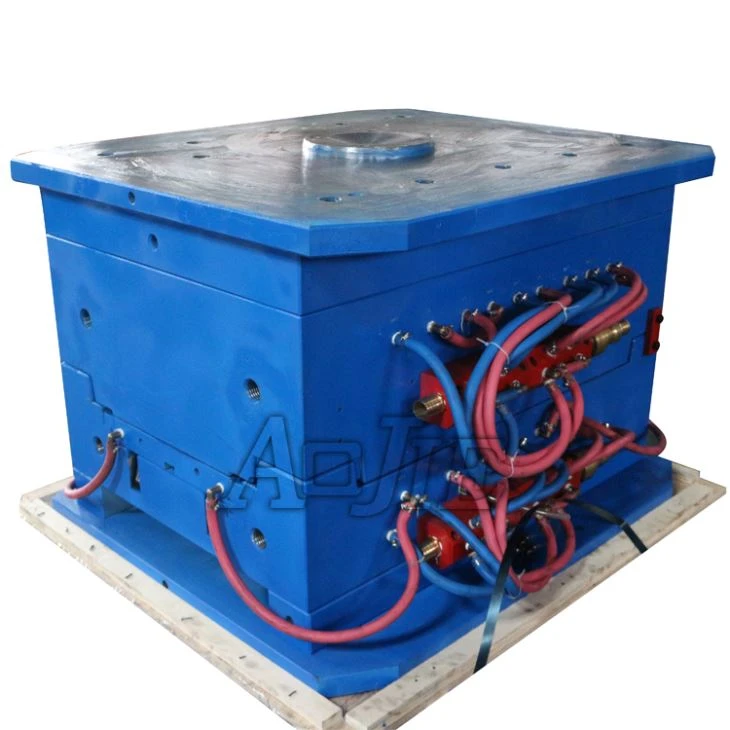
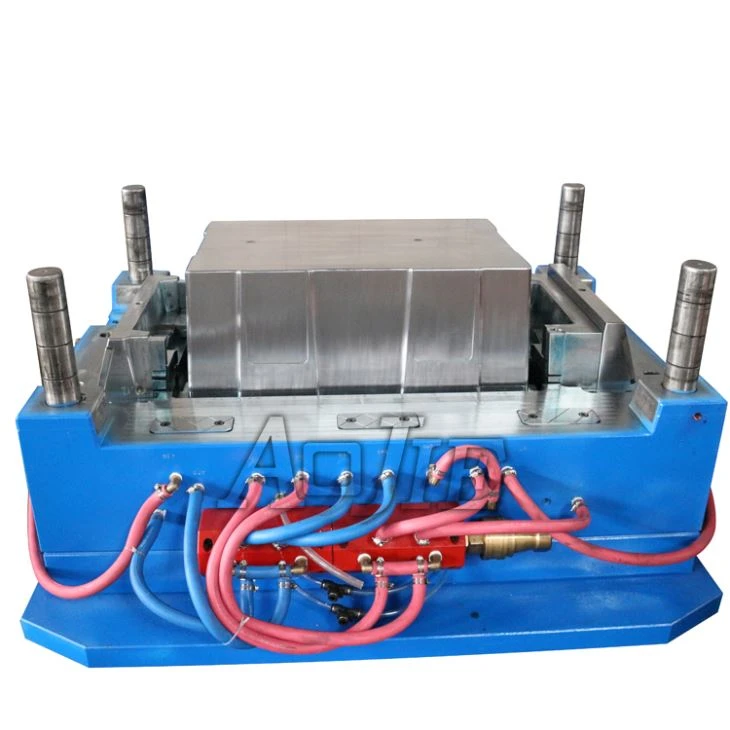
Another big issue: dimensional accuracy and uniformity across the entire crate. Big crates aren’t just one straight line—they have walls, handles, reinforcing ribs, and sometimes integrated lids. Shrinkage doesn’t happen evenly across all parts of the mould. For example, thick sections like the base of a crate will shrink more than thin walls, because it takes longer to cool. If you don’t account for that differential shrinkage, you’ll end up with a warped crate—one that tilts when stacked, or has a lopsided lid that won’t seal. Warping might seem like a small thing, but for crates stacked 10 high in a warehouse, a warped bottom crate can cause the whole stack to collapse. We’ve seen that happen too: a grocery client’s meat crates (you can check our plastic meat crate moulds for that use case) came out warped, and 20% of them were damaged during transit because the lid wouldn’t lock. They had to recall a shipment worth $120k—all because someone skipped shrinkage calculations.
Wait, but not all shrinkage is bad, right? No, here’s the thing: we can actually use shrinkage to our advantage when designing moulds. For big crates, we can tweak the mould’s cooling channels to control how fast different parts of the cavity cool, which evens out shrinkage. For example, the reinforcing ribs on a crate’s side cool faster than the base, so we make the mould’s base cooling system a bit more efficient to slow that shrinkage. We also use simulation software to map out expected shrinkage across the entire mould before we even start machining. That saves us and our clients so much time and hassle—we don’t have to do test runs over and over to adjust sizes.
Let’s also touch on how shrinkage interacts with different types of crates, because that’s a big part of why clients come to us for specialized moulds. We’ve done plastic beer crate moulds, plastic food crate moulds, even plastic liquid milk crate moulds. Each of these uses a different plastic grade, which means a different shrinkage rate. For beer crates, they need to be rigid enough to stack heavy cases, so we use a stiffer HDPE with a lower shrinkage rate (around 1.8-2.2%). For milk crates, which are often opaque and need to hold liquid, we use a high-melt HDPE with a slightly higher shrinkage (2.5-3%). If we mixed those up, the beer crates would be too small to fit standard beer bottles, and the milk crates would warp when filled with cold milk. It’s all about matching the shrinkage rate to the end use of the crate.
I get it—for someone not in the mould-making business, shrinkage can feel like a random, frustrating variable. But for us, it’s just part of the process. We’ve cut corners before, back when we were younger, and it cost us clients. Now, we make sure every mould we design includes a shrinkage profile tailored to our client’s exact plastic material. We also provide test mould runs with small batches so clients can check dimensions before they invest in full production.
So, if you’re in the market for a plastic big crate mould—whether it’s for shipping, storage, or any other use—don’t just look at the price. Ask the mould supplier how they account for shrinkage rate. Ask if they test your specific plastic grade, if they use simulation software, and if they offer test runs. Cheap moulds that skip those steps might save you a few bucks upfront, but they’ll cost you way more in material waste, production delays, and defective products down the line.
At the end of the day, a good mould isn’t just a hunk of steel shaped like a crate. It’s a design that accounts for every tiny detail, including shrinkage. That’s why we’ve been able to build long-term relationships with our clients—they know we don’t cut corners on stuff that matters, like shrinkage. If you’re looking for a reliable plastic big crate mould, or even specialized ones like the plastic crate injection mold for a specific use case, hit us up to chat through your needs. We’re here to make sure you get a mould that works right the first time, no shrinkage surprises.
References:
- Rosato, D. V., & Rosato, M. G. (2000). Injection Molding Handbook. Springer.
- Crawford, R. J. (2013). Plastics Engineering. Butterworth-Heinemann.
- American Society for Testing and Materials (ASTM D955-17). Standard Test Method for Shrinkage of Thermoplastics.
- Grewell, D. A., Benatar, A., & Park, J. B. (2007). Plastics and Composites Processing Handbook. CRC Press.