

Yo, what's up everyone! I'm a supplier of Plastic Pallet Moulds, and today I wanna chat about the technical specifications of these bad boys.
First off, let's talk about the materials. The quality and type of material used in a plastic pallet mould are super crucial. Most of the time, we use high - grade steel alloys. These alloys are tough as nails, which means they can withstand the high pressure and temperature during the injection moulding process. High - grade steels like P20 and H13 are our go - to choices. P20 is great because it has good hardness and machinability. It's also got decent corrosion resistance, which is a big plus when you're dealing with plastic and the chemicals that might be involved in the process. H13, on the other hand, is known for its excellent thermal fatigue resistance. This is important because the mould is heated and cooled multiple times during production, and H13 can handle that stress without cracking or deforming easily.
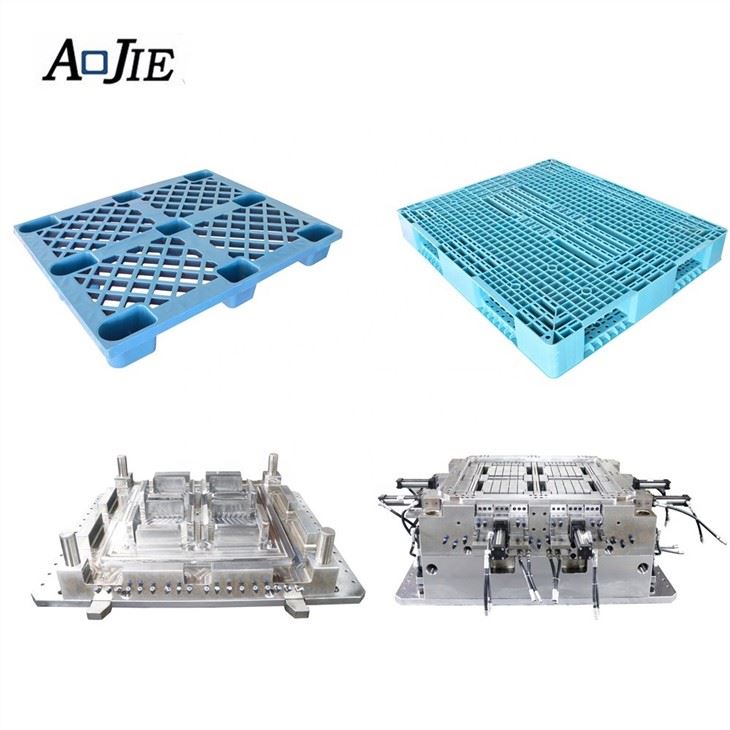
Now, let's get into the design of the plastic pallet mould. The structure design is key to ensure the quality and efficiency of the plastic pallet production. You've got different types of pallet designs, like single - layer pallets and double - deck pallets.
For Single Layer Pallet Mould, the design is relatively simple compared to some of the more complex models. It's mainly used for light - duty applications. The mould for a single - layer pallet usually has a straightforward cavity design, which allows for quick injection and easy demoulding. The main thing here is to make sure that the pallet has a flat surface and uniform thickness. This is essential for the pallet to be stable when it's carrying goods.
On the contrary, Plastic Double - deck Pallet Mould is designed for heavier loads. The double - deck structure provides more support and stability. The mould design for this type of pallet is more complex. It needs to create two separate layers that are well - connected. The cooling system in a double - deck pallet mould is also more sophisticated. You need to ensure that both layers cool evenly to prevent warping and ensure the overall strength of the pallet.
Another important technical aspect is the size and precision of the plastic pallet mould. The size of the mould depends on the size of the pallets you want to produce. There are standard sizes for pallets in different industries. For example, in the logistics industry, pallets often come in sizes like 1200mm x 1000mm or 1100mm x 1100mm. So, the mould has to be accurately designed to produce pallets of these specific sizes.
Precision is also a big deal. The tolerance level of the mould should be extremely low. A high - precision mould ensures that each pallet produced has the same dimensions and quality. Even a small deviation in the mould can lead to pallets that don't fit properly on conveyor belts or storage racks. We use advanced machining tools and techniques to achieve the required precision. Computer - Numerical - Control (CNC) machining, for example, is commonly used to make sure the mould is as accurate as possible.
Let's talk about the injection system in a Plastic Pallet Mould Injection Moulding Machine. The injection system is responsible for melting the plastic and injecting it into the mould cavity. There are different types of injection systems, such as plunger - type and screw - type. The screw - type injection system is more popular these days because it can provide better plasticization and more consistent injection pressure.
The size of the injection unit matters too. It should be able to handle the amount of plastic needed to fill the mould cavity for a single pallet. If the injection unit is too small, you won't be able to fully fill the mould, resulting in incomplete pallets. On the other hand, an overly large injection unit can be wasteful and increase production costs.
Cooling is another vital part of the plastic pallet mould process. After the plastic is injected into the mould, it needs to cool and solidify quickly. A good cooling system can significantly reduce the cycle time of production. The cooling channels in the mould are designed to ensure that the plastic cools evenly. If the cooling is uneven, the pallet might warp or develop internal stresses, which can affect its strength and durability. We usually use a water - based cooling system because water is an excellent coolant and is cost - effective.
Ejection is the final step in the production process. The mould needs to have an efficient ejection system to remove the finished pallet from the mould cavity. There are different ejection methods, like ejector pins and ejector sleeves. Ejector pins are commonly used because they are simple and effective. They push the pallet out of the mould once it has cooled and solidified. However, the layout of the ejector pins needs to be carefully designed to avoid leaving marks on the pallet surface.
Now, let's talk about the manufacturing process of a Pallet Plastic Injection Mould. It all starts with the design phase. Our design team uses advanced 3D modelling software to create a digital model of the mould. This allows us to simulate the injection process, check for any potential design flaws, and make adjustments before the actual manufacturing begins.
Once the design is finalized, we start the machining process. As I mentioned earlier, CNC machining is a key part of this. It cuts the steel block into the desired shape with high precision. After machining, the mould goes through a heat - treatment process to increase its hardness and durability. Then, it's polished to achieve a smooth surface finish, which is important for easy demoulding and to ensure the quality of the pallets.
When it comes to Plastic Pallet Mould Making, quality control is always on top of our list. We have a strict quality control system in place. Every mould goes through a series of inspections before it leaves our factory. We check the dimensions, hardness, surface finish, and functionality of the mould. This ensures that our customers receive a high - quality product that meets their requirements.
If you're in the market for plastic pallet moulds, we've got you covered. Our moulds are made with the latest technology and high - quality materials. We can customize the moulds according to your specific needs, whether it's the size, design, or any other requirements. We're committed to providing the best products and services to our customers. So, if you're interested, don't hesitate to reach out and start a discussion about your procurement needs.
References

- Injection Moulding Handbook, Second Edition, by T. Turner
- Plastic Mould Design, by C. Rosato